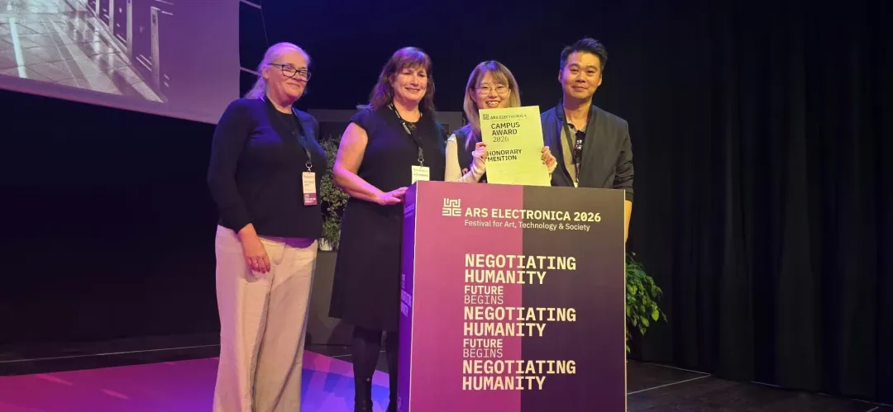
Over the past four years, the Computational Media and Arts (CMA) Thrust within the Information Hub at The Hong Kong University of Science and Technology (Guangzhou), (HKUST(GZ),) has grown from its first appearance on the international media art stage to its fourth consecutive presentation at Ars Electronica in Linz, Austria. This year, CMA brought together six student artworks and received its first Honorary Mention at the Ars Electronica Campus Award 2026. This recognition reflects years of sustained teaching and creative practice. What began as an exploratory venture in Linz has become a regular international showcase for the Information Hub and the CMA Thrust.
In Continuous Pursuit: The Fruits of CMA's Creative Practice
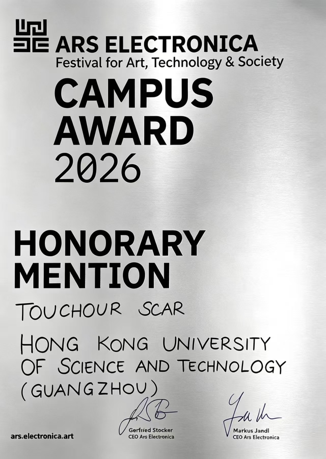
From Nansha in Guangzhou, China, to Linz, Austria, and from campus studios to an international arts festival, four years of continuous exploration have brought new recognition. From 8 to 13 September 2026, CMA PhD student artists and their artworks took part in the annual Ars Electronica Campus Exhibition in Linz. CMA has participicated every year since it’s inception in 2022 at this international media art exhibition. Touch Our Scars by Yufan Li and Qing Yang, one of the artworks presented by CMA, received an Honorary Mention at the Campus Award 2026, recognizing the faculty and students’ research at the intersection of art, technology, and society.
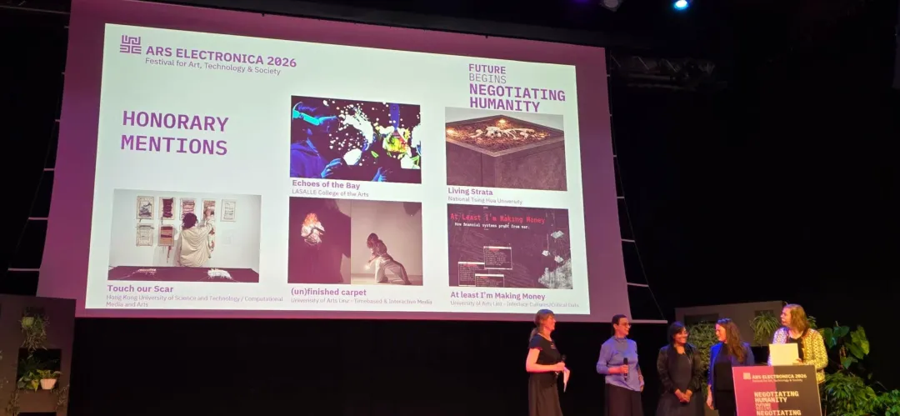
This year’s Ars Electronica Campus Exhibition brought together 45 art schools and universities from around the world. Presented in a shared exhibition space under the theme ‘Reality Flux: Sensing the Unseen’, CMA’s artworks encompassed interactive installations, generative sculpture, robotic art, multi-channel moving image and interactive textiles. Visitors were invited to participate through gaze, touch, writing and voice, exploring relationships among bodies, technology and the environment that are not readily perceptible. Throughout the exhibition, a steady stream of international visitors engaged with the works and their creators, responding with enthusiasm.
Echoes from the Floor: Encountering CMA’s Media Art On-Site
1. Unseen Realm
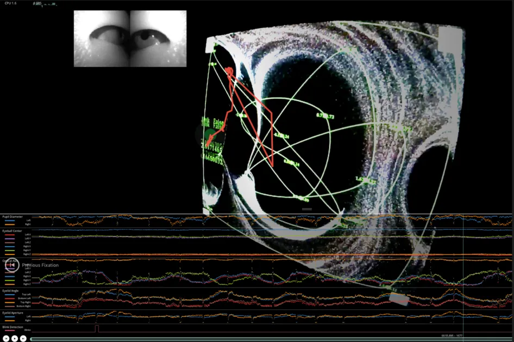
Unseen Realm is an interactive projection installation driven by real-time eye tracking. Visitors’ gaze, saccades and blinks disturb a virtual cosmos composed of 64,000 particles while reshaping the generative cosmic textures projected onto the installation’s surface. Through on-site scanning, image capture and algorithmic reconstruction, the artist connects the geological traces of industrial activity with cosmic forces such as dark matter and dark energy. Once the viewer’s eyes enter the system, looking is no longer passive: eyes and cosmos affect one another, jointly generating the work’s continuously changing reality.
2. Touch Our Scars
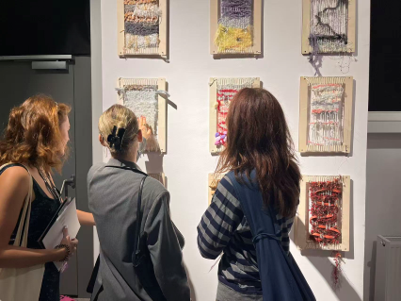
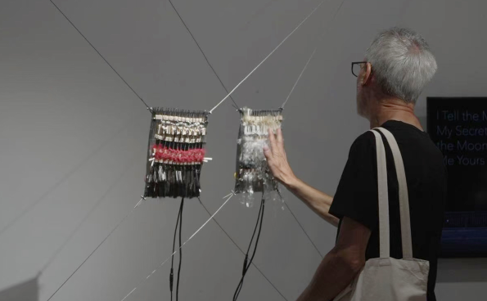
Touch Our Scars uses textiles, bodies and interactive systems to explore trauma as a non-verbal, embodied experience. The installation comprises two interactive textiles generated from accounts of collective trauma, alongside nine tactile works drawn from individual experiences of trauma. Sharp, rigid materials that resist bodily contact are woven into traditional textile structures. Visitors may approach, observe, linger, step back or reach out to touch these surfaces. Rather than turning suffering into a spectacle, the work invites audiences to confront the hesitation and responsibility involved in touching another person’s scars, as well as the potential for transformation that such an act may hold.
3. Becoming Space
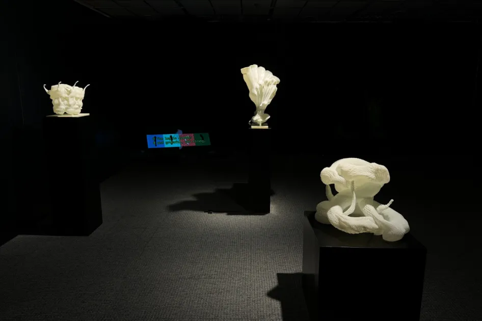
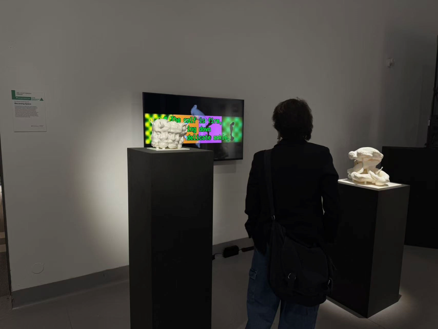
Becoming Space brings together three 3D-printed resin sculptures, generative AI processes and moving image. Drawing on the transformations between humans and animals in Ovid’s Metamorphoses, the artwork reconsiders identity, embodiment and power under contemporary technological conditions. Text prompts, 3D generative models, algorithms, machines and materials all participate in shaping the sculptures. Human and animal bodies no longer retain stable boundaries but transform into one another through an ongoing process of change. Here, generative AI is not merely a tool for depicting predetermined images, it participates in an open-ended process of becoming.
4. BruSHŪ
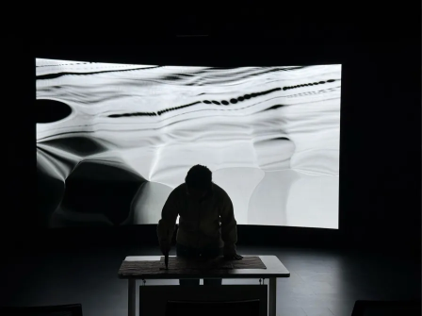
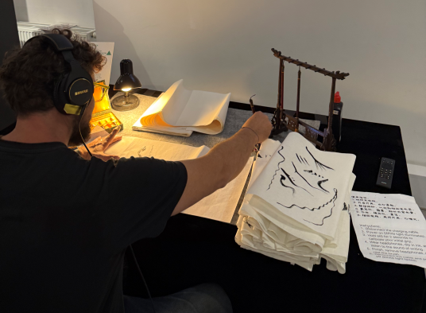
Chinese calligraphy is usually encountered as silent, completed brushwork. The approach, hesitation, turning, contact with the paper, lifting and renewed contact that constitute the act of writing largely disappear from the final marks. BruSHŪ transforms a sensor-embedded calligraphy brush into a cross-modal perceptual instrument, capturing its orientation, motion intensity and distance from the paper in real time. These signals are translated into sound and evolving visual textures, making the tacit rhythms and decisions of writing perceptible. The work neither judges the quality of the calligraphy nor attempts to reconstruct the marks left behind. Instead, it transforms the brush from a tool for making marks into an interface for sensing embodied knowledge.
5. I Tell the Moon My Secret and the Moon Tells Me Yours
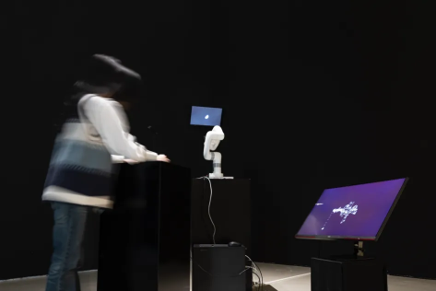
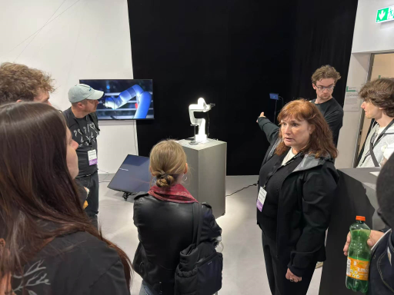
In I Tell the Moon My Secret and the Moon Tells Me Yours, visitors are invited to speak a secret into a microphone. Their voices are translated into waveforms, coordinates and trajectories for a robotic arm. Using the Moon as its sole light source, the arm then traces these encoded secrets through long-exposure photography. Even when the robot follows each trajectory precisely, the resulting image still depends on the lunar phase, cloud cover, air quality and whether the Moon enters the camera’s field of view. The natural environment thus becomes an active, uncontrollable collaborator rather than a passive backdrop. Whether the secret appears or dissolves into the night, it remains a secret, translated into another language.
6. KARMA
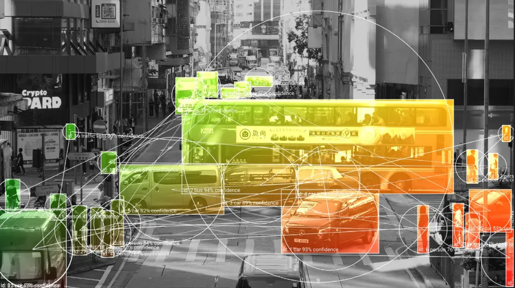
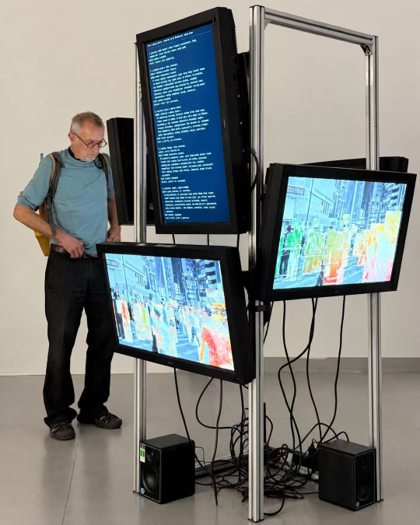
KARMA is a multi-channel audiovisual installation that explores generative AI through the artist’s framework of ‘sensory projection’. It imagines high-dimensional latent space as an ‘algorithmic cosmos’ comprising vast datasets and countless possibilities. Human prompts, parameter settings and artistic judgements intervene in this field, guiding latent possibilities into perceptible images and sounds. Across multiple screens, real-world urban footage, AI-generated imagery, text, detection boxes and granular-synthesis soundscapes overlap, dissolve and recombine. The title points to the recurring cycles of causality and feedback within generative systems. The work asks: when human perception continually shapes algorithms, and algorithms in turn reorganize how we perceive reality, how do reality, aesthetics and meaning emerge?
Ars Electronica as our landmark: onward to more world stages
This year’s CMA exhibition was jointly curated by Professors Clea von Chamier-Waite (lead curator), Ingeborg Reichle, and James She. Bringing perspectives from artistic practice, media theory and technology research, the three professors provided academic support and exhibition guidance for the event. The Campus programme involved 45 art schools and universities. CMA at HKUST(GZ) and the Division of Arts and Machine Creativity (AMC) at HKUST presented their selected student artists and artworks in a shared space to great success, attracting a continuous flow of international visitors and enthusiastic responses.
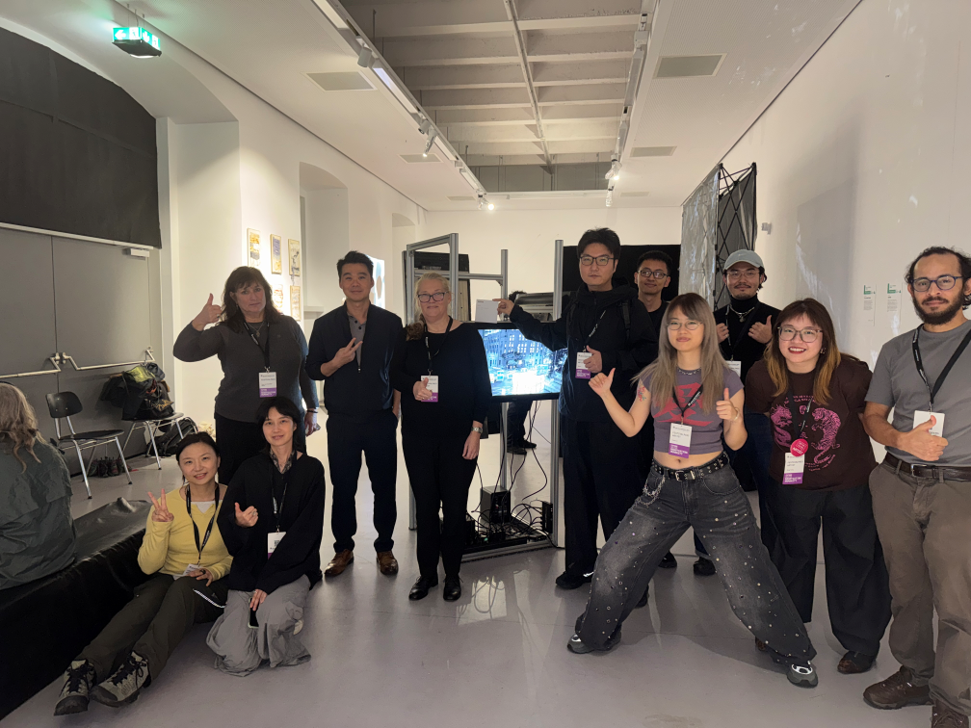
CMA made its presence felt throughout the 2026 Ars Electronica Festival
Beyond the Campus Exhibition and the Honorary Mention awarded to a student artwork, CMA’s participation this year extended to a range of events across the festival.
Professor Ingeborg Reichle’s new co-edited publication, NaturArchy: Towards a Natural Contract (European Union / Quodlibet, 2026), was presented at a major book launch held by the European Commission’s Joint Research Centre during the festival. Bringing together interdisciplinary collaborations across art, science and policymaking, the publication examines relationships between humans and nature, extending the dialogue between artistic practice and public concerns in perspective to ecological governance and new imaginaries for coexistence.
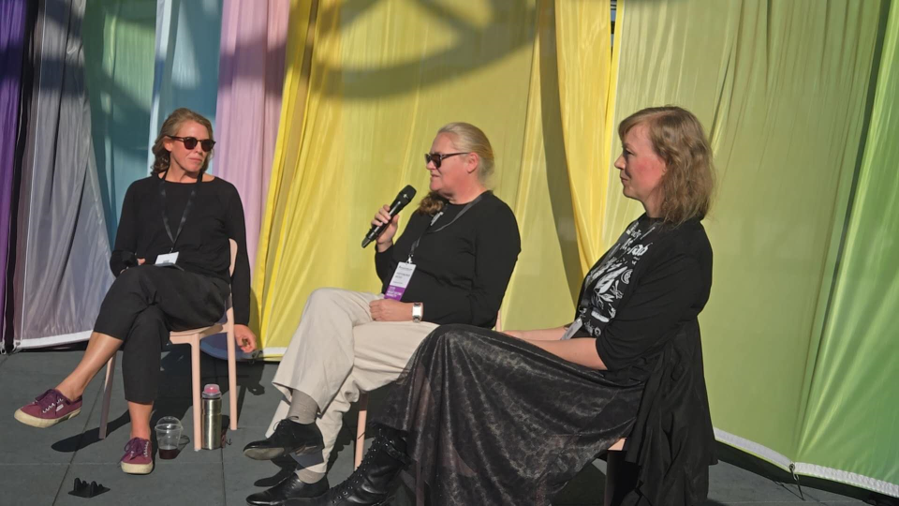
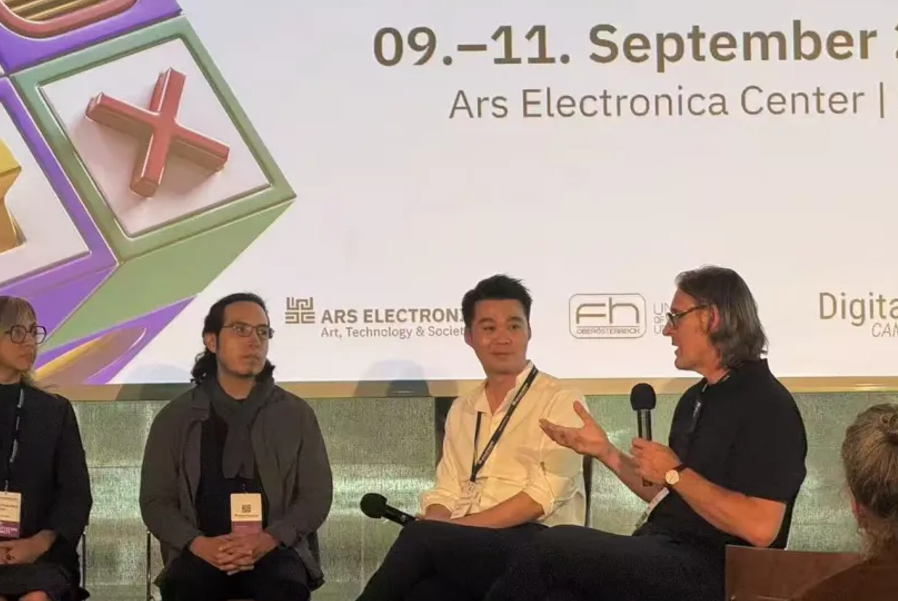
Professor James She delivered a presentation at the Expanded Animation Forum of the Ars Electronica Festival. As one of the festival’s flagship events, the forum transcends the boundaries of conventional animation and media art, covering interactive works and AI-generated videos. It reshapes the discourse within animation and media art circles and has influenced the award framework of the Prix Ars Electronica. In partnership with ACM SIGGRAPH, the forum disseminates cutting-edge research in media art. Chairs of SIGGRAPH, SIGGRAPH Asia, and ISEA also participated in the session. Representing VINCI, Professor She articulated the vision and joint initiative for collaboratively building a research community for media art.
Professor Omar Costa Hamido, returned to the festival for a second consecutive year with QC-PAINT, a collective of artist-researchers and physicists exploring art and science through quantum computing. Co-created by Costa Hamido with Arianna Crippa, Paulo Itaboraí and Karl Jansen, the collective exhibited Colliding Counterparts in the Ars Electronica Center exhibitions. The work brings together quantum computing, particle physics, engineering and oil painting. It is conceived as a grid of rotating, double-sided painted tiles, each representing a qubit, whose movements follow a quantum-computer simulation of particle scattering. At the festival, a working prototype was shown alongside an explanatory video.

CMA’s participation in this year’s Ars Electronica Festival extended beyond a single exhibition or award. For the Information Hub and CMA Thrust at HKUST(GZ), four consecutive appearances in Linz represent an ongoing presence at a leading international media art platform, bringing the outcomes of teaching and creative practice to the attention of peers worldwide. A shared curatorial theme and a group of six artworks also offered a focused presentation of the university’s approach to interdisciplinary education, raising the international visibility of the university and the Information Hub. For students, taking their work beyond campus exhibitions and responding to questions and discussions with international audiences provides direct academic experience outside the classroom and places their creative practice in a global context from the outset. For the Thrust’s academic development, the connections between award recognition, conference exchanges and publication launches are turning individual exhibition appearances into a sustainable network of international collaboration. Across artwork presentations, curatorial collaboration, publication events and conference contributions, students tested their ideas in an international media art setting, supported by the expertise and organizational work of faculty and curators. Sustained investment is producing visible results and laying the groundwork for broader exchanges in the future.
As the exhibition closes, its legacy extends beyond the works and the award to new exchanges and ideas across media art, technology and culture. We look forward to seeing more creative work from CMA enter wider public spaces and connect with new global audiences.